

© 2026 All rights reserved.

A lot of people still think that websites are only for online stores. In other words, if a business does not sell products online, they assume there is no real need for a website.
But the reality is very different.
Today, a website is much more than an online store. A professional website can act as a digital storefront, a company's online office, a product catalog, a trust-building tool, a customer acquisition channel, and one of the most important parts of a brand's digital identity.
The larger, more professional, and more demanding your customers are, the more important a professional website becomes.
Think about your own behavior when you are considering working with a new company. You may search for the company's name on Google, look at its website, check its services, read about its previous projects, and try to understand whether the company is legitimate and trustworthy.
Your potential customers are doing the same thing.
So, which types of businesses really need a website?
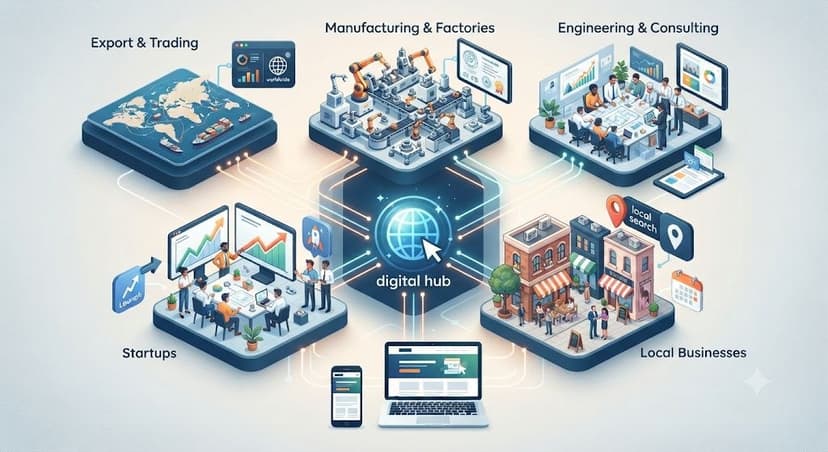
Trading companies, exporters, importers, wholesalers, and businesses that work with customers or commercial partners locally and internationally are among the businesses that can benefit the most from having a professional website.
Trust is one of the most important factors in commercial relationships.
Before contacting a company, a potential customer or business partner may want to learn about its history, areas of expertise, products, target markets, certifications, capabilities, and previous experience.
A professional website can bring all of this information together in one organized and credible place.
For an export company, a website can include information about the company, export products, target countries, quality standards, certifications, supply capacity, cooperation opportunities, and sales contact information.
Having an English or multilingual version of the website can be particularly valuable for companies working with international markets.
Imagine that an international buyer hears about a company and searches for its name on Google. If they find a professional website with clear information about the company and its products, they can quickly understand who they are dealing with.
On the other hand, if the company has no official website, or its website looks outdated, incomplete, or unprofessional, an important business opportunity could be lost before the first conversation even happens.
A website can also work as an online catalog for trading companies.
Instead of repeatedly sending different PDF files and answering the same basic questions, a company can publish its products and services on its website and simply send customers links to the relevant pages.
For export and trading businesses, therefore, a website is not simply a marketing tool. It can become an important part of the company's commercial infrastructure and brand credibility.
Manufacturers, factories, and industrial companies are another major group that can benefit significantly from having a professional website.
At first, you might think that a factory does not need a website because its products are not sold directly online.
But in many industrial and B2B businesses, a website can actually be more important than an online store.
Food manufacturers, metal companies, textile manufacturers, chemical companies, component manufacturers, industrial equipment suppliers, raw-material producers, and many other B2B businesses need a professional way to communicate their capabilities.
An industrial customer usually wants detailed information before making contact.
What products does the company manufacture?
What is its production capacity?
What are the technical specifications?
Which standards and certifications does it have?
Where is the factory located?
How can a customer request a quotation or sample?
A professional industrial website can answer all of these questions.
Product pages, online catalogs, technical specifications, production-line photographs, certifications, completed projects, case studies, and quotation-request forms can all become important parts of an industrial website.
A website can also help manufacturers become visible in Google searches.
A potential customer may not know your company by name. Instead, they might search for something like "industrial component manufacturer," "metal sheet manufacturer," or "food manufacturing company."
With the right content and SEO structure, your website can attract these potential customers.
For many factories, a website is not an online store.
It is a digital catalog, a showcase of capabilities, and a channel for attracting new business opportunities.
Engineering firms, consulting companies, law firms, accounting firms, architecture studios, contractors, and other professional service businesses also need a strong online presence.
For these types of businesses, customers are not simply buying a physical product. They are evaluating the expertise, experience, and credibility of the people providing the service.
When someone is looking for an engineering company or consultant, they usually want to know:
What services does the company offer?
What projects has it completed?
Who is on the team?
What areas does it specialize in?
Can the company be trusted?
A professional website can answer many of these questions before the first phone call or meeting.
For an engineering company, a project portfolio can be particularly valuable.
Showing previous projects with descriptions, images, services provided, and results can communicate far more than a short social media post.
For consulting businesses, publishing expert articles, case studies, team profiles, and detailed service pages can help establish authority and credibility.
The same principle applies to lawyers and accountants.
When people search Google for answers to specific legal, financial, or business questions, useful expert content can introduce them to your company before they are even actively looking for a service provider.
For professional service businesses, a website can therefore be much more than an online business card.
It can become a serious trust-building and lead-generation tool.
Startups and early-stage companies can also benefit from having a professional website from the very beginning.
A startup may not even have a fully launched product yet, but a website can still be used to introduce the idea, attract early users, introduce the team, collect email addresses, present the product, or communicate with potential investors.
For apps and online platforms, the website is often one of the first places where users, partners, and investors go to learn more about the product.
A strong landing page should quickly answer a few important questions:
What problem does the product solve?
Who is it for?
How does it work?
Why should someone use it?
A website can also become a testing and growth platform for a startup.
It can be used for marketing campaigns, user registrations, lead collection, landing-page experiments, and testing different value propositions.
For a startup, the website is not simply a place to publish information.
It can become part of the product's growth strategy.
Even if the main business operates through a mobile application, a professional website can still be valuable for SEO, product discovery, support, landing pages, user acquisition, and brand credibility.
Cafés, restaurants, stores, salons, beauty businesses, gyms, clinics, and other local businesses can also benefit from having a professional website.
At first, it may seem like having an Instagram page is enough.
But social media and a website serve different purposes.
Social media is excellent for daily communication, content publishing, community building, and engagement.
A website, on the other hand, can act as the official and permanent information hub for the business.
For example, a restaurant can use its website to publish its full menu, opening hours, address, phone number, reservation options, photos, and information about its services.
A beauty salon can showcase its services, portfolio, team members, and booking options.
A local store can publish its products, services, locations, opening hours, and contact information.
Local search is another important reason for businesses to have a website.
When someone searches for something like "restaurant near me," "best café in [city]," or "beauty salon in [neighborhood]," having a strong online presence can increase the chances of being discovered by potential customers.
This means that even if your business does not sell anything online, a website can still help bring more people through your physical doors.
This is a question many business owners ask.
The short answer is: social media and websites are not complete replacements for each other.
Social media can be extremely effective for building an audience, sharing content, showing your work, and communicating with customers.
But a website gives you a different level of structure and control.
On your website, you can create dedicated pages for every service and product, publish long-form content, target Google search keywords, create inquiry forms, organize information, and build a clear path from visitor to potential customer.
There is also an important psychological factor.
When someone searches for your company by name on Google, they often expect to find an official website.
Having one can immediately make the business feel more established and credible.
That is why the best approach for many businesses is not choosing between a website and social media.
It is using both.
Social media can attract and engage your audience, while your website can provide deeper information, establish credibility, and guide visitors toward taking action.
The value of a website is not limited to how attractive it looks.
A professional website should serve real business objectives.
A professional design, complete company information, project portfolio, team introduction, certifications, and real contact details can help create a stronger first impression.
Unlike a social media post, a website gives you the space to provide detailed information.
You can create dedicated pages for products, services, industries, projects, and frequently asked questions.
With useful content and a solid SEO strategy, your website can become a source of organic traffic and introduce your business to people who are actively searching for what you offer.
Contact forms, consultation requests, quotation requests, booking systems, registrations, and other conversion tools can turn website visitors into potential customers.
A professional domain and a well-designed website give your business a clear digital identity and help create a more consistent brand experience.
Social media platforms, algorithms, and trends can change.
Your website can remain the central digital home of your business and grow alongside it.
There is no single answer that applies to every company.
However, there are several signs that indicate your business may be ready for a website.
If customers research your company before buying, if you work with other businesses, if you provide professional services, if you want to attract customers through Google, if you plan to expand into new markets, or if you have a lot of information that customers need before contacting you, then a website is probably more than just a nice-to-have.
Even if most of your customers currently come through referrals, phone calls, or social media, a website can strengthen those channels.
You do not need to wait until your business becomes completely digital.
Sometimes, a professional website is exactly what helps a traditional business take the next step in its growth.
One of the biggest mistakes businesses make is assuming that every company needs the same type of website.
A factory does not have the same needs as a restaurant.
An export company may need a multilingual website, product pages, technical information, and business inquiry forms.
An engineering company may need a strong project portfolio and detailed service pages.
A restaurant may prioritize its menu, reservations, location, and opening hours.
A startup may need a landing page, user registration, product demonstrations, and conversion-focused pages.
This is why website design should start with the actual needs of the business rather than simply choosing a template.
The right question is not:
"What kind of website should we have?"
A better question is:
"What problem should our website solve for our business?"
Once that question is clear, the structure, features, content, and design of the website can be built around the business's actual goals.
Simply having a website is not enough.
A slow, outdated, confusing, or unprofessional website can actually hurt the perception of a brand.
A professional website should be fast, responsive, mobile-friendly, and easy to navigate.
Visitors should be able to find the information they need without having to search through confusing menus or poorly structured pages.
Content is equally important.
A few generic marketing sentences and attractive images are not enough.
Visitors should be able to understand your services, products, experience, projects, advantages, and contact options clearly.
SEO should also be considered from the beginning.
Page titles, meta descriptions, clean URLs, useful content, internal linking, website speed, mobile usability, and overall user experience can all contribute to better search visibility.
Security and maintenance are important as well.
A professional website should be technically maintained, secure, and regularly updated so that both the information and the user experience remain reliable.
If you still think that websites are only for online stores, you may be overlooking one of the most valuable roles a website can play in modern business.
Export and trading companies can use websites to build credibility and connect with international partners.
Manufacturers and factories can use them to showcase products, production capabilities, certifications, and technical information.
Engineering and consulting companies can use websites to demonstrate expertise, experience, and previous projects.
Startups can use websites to introduce their products, attract users, test ideas, and build credibility.
Local businesses can use websites to help potential customers discover their services, find their location, check their opening hours, view their offerings, and get in touch.
Ultimately, having a website does not mean that your business needs to sell products online.
A website can be your digital storefront, online catalog, company profile, trust-building platform, customer acquisition channel, and the digital home of your brand.
And the more professional, valuable, and demanding your customers are, the more important your online presence becomes.
So perhaps the real question is not:
"Does my business need a website?"
Instead, ask yourself:
"If a potential customer searches for my business on Google today, what will they find?"
Are you an export company?
A manufacturer?
An engineering or consulting firm?
A startup?
Or a local business?
Every business has different needs, and your website should be designed around those needs.
If you are not sure what role a website could play in growing your business, start by identifying your main goal.
Do you want to build your brand?
Generate more leads?
Sell products?
Receive quotation requests?
Accept bookings?
Present your services?
Or become more visible on Google?
Once the goal is clear, the website can be designed to support that goal in a focused and measurable way.
28 Aug 2026 • Content Team